If you've ever searched size 46 in us and gotten four different answers, you are not imagining things. Clothes sizing is a label, not a law. In my alterations notebook, the same number can show up on a knit sweater, a structured blazer, and a dress with no stretch at all, and each one behaves differently once it hits a human body. The inside tells the truth, and the inside rarely cares what the hangtag says.
What size 46 in us usually means on a women's chart
For women's ready-to-wear, size 46 in us often lands around a US 14 or 16, and sometimes a 12 in a generous cut or an 18 in a trim one. That sounds messy because it is. One brand builds for ease through the waist and hip, another cuts closer through the upper arm, and a third quietly adds enough room in the bust that the garment feels one size larger even when the tag says the same thing.
I care less about the number and more about the measurements behind it. If you have a 42-inch bust, 34-inch waist, and 44-inch hip, a chart that promises a perfect match on a 46 label is only telling you that the math started somewhere near your body. It is not telling you where the shoulder seam will sit, whether the sleeve cap will bite, or whether the skirt will swing away from the hip instead of clinging to it.
A men's 46 jacket is a different animal entirely. That number usually points to chest size, not the same women's fit grade, which is why a label can be perfectly clear and still completely useless if you do not know the category it belongs to. That is garment math for you. Neat on paper, temperamental in the fitting room.
Why the inside matters more than the number
When I turn a garment inside out, I look first at the seam allowance. If there is enough room to let something out, that tells me the maker expected real bodies and real variation. If the seam allowance is skimpy, the garment was built to look tidy on a size chart, not to be rescued later. Same with darts: a bust dart that points to the wrong place is a clue that the pattern was graded up without really being redesigned.
Fabric changes everything. A woven rayon dress with no stretch needs room to move, so the chart has to work harder. A ponte knit can forgive a waistline that sits half an inch off. A blazer lined in slippery polyester will feel different from one lined in a cotton blend even when the outer measurements are identical. That is why one person's perfect fit is another person's one-wear headache. The tag is only the opening bid.
A good shopping habit is to compare the flat measurements of a garment to your body measurements, then add the ease you actually want. For a fitted top, you may want an inch or two of ease at the bust. For a coat, you want enough room for a sweater without turning into a square. The number on the label never tells you that part.
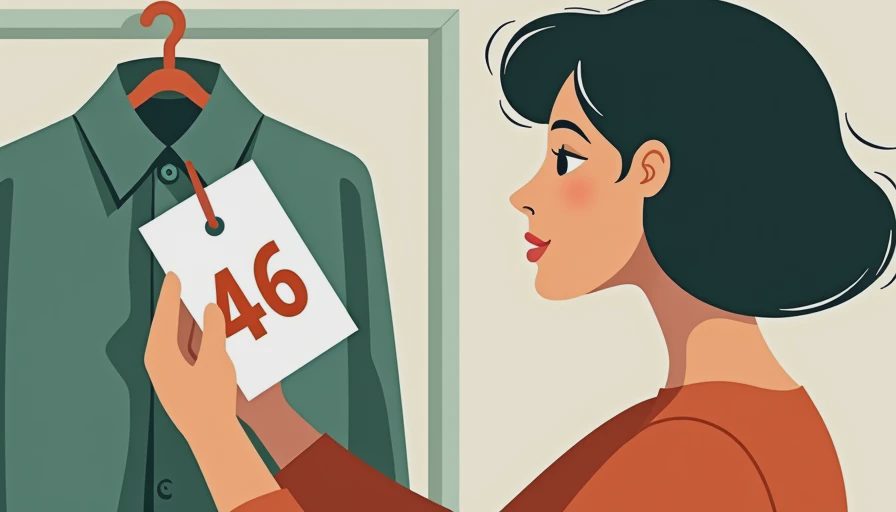
How to measure before you order
Measure your bust, waist, high hip, full hip, shoulder width, and inseam with a soft tape, and do it over thin clothing so the numbers are honest. Then compare those measurements to the brand chart and, when possible, to the garment measurements in the product details. That second set is the one I trust more. A chart may tell you that a size runs large, but the garment measurement will tell you whether the waist is actually 32 inches or 35, which is what matters when the zipper is on the line.
If you are between sizes, choose by the part of the garment that is hardest to alter. Hips and waist can often be taken in. Shoulders are a different animal. A shoulder that is too narrow pulls the whole garment upward and changes the line of the sleeve. A bust that is too small can flatten the front and make buttons pull in a way no steam iron can fix. You want the bones of the garment to match your frame before you start worrying about the finishing touches.
For a woman who usually wears size 46 in us, that means checking the pattern of the garment, not just the number. A wrap dress may be forgiving because it can be cinched. A sheath dress may demand a closer measurement match. Once you see that pattern, shopping gets less random and a lot less insulting.
When tailoring can save the fit
A size 46 in us that is close in the shoulders, bust, and upper back is usually worth tailoring. Waist suppression is straightforward on many dresses and skirts. Hemming is almost always doable, whether that means taking three inches off a pair of trousers or letting a midi dress land at the shin instead of the ankle. Sleeves can often be shortened, too, if the cuff detail does not get wrecked in the process.
What I would not promise is a miracle. Taking in side seams by an inch or two is normal. Moving a shoulder seam or rebuilding a bust shape is a different job entirely, and the price reflects that. In many cities, a simple hem may run $20 to $40, waist adjustments around $25 to $60, and more involved jacket work can climb much higher. A garment that needs major reconstruction is not automatically a bad buy, but it should be cheap enough that the alteration bill still makes sense.
The best buys are the ones with a little seam allowance, a clean lining, and a shape that already respects your body. That is where the money goes farther.
Shopping size 46 in us without guessing
If you want fewer returns, start by reading the fit notes like a person who has actually unpicked clothing. Look for words like relaxed, tailored, oversized, fitted, and slim, because those are clues about ease. Read reviews for the same body clues you would use in a fitting room: bust room, arm comfort, rise, and where the hem lands. One person saying a blouse was perfect and another saying the sleeves were tight is more useful than a glowing five-star summary that tells you nothing.
Try garments on with the underpinnings you actually wear. A bra that gives you a different shape will change the way the waist sits. So will shapewear, even if we all pretend otherwise. If you are buying online and the return window is decent, ordering two sizes is often cheaper than gambling on one and paying shipping twice later. That is not indulgent. That is math.
When a size 46 in us looks good on the rack but wrong on your body, do not assume the body is the problem. Most of the time the cut is the problem. A label cannot see your shoulder slope, your rib cage, or the fact that your left hip sits a little differently from your right because bodies are built by life, not by a ruler. That is exactly why the inside tells the truth, and why the best shopping habit is to trust the garment enough to inspect it, but not enough to believe the number.


No notes yet — write the first one.